Thailand is entering a challenging period for its labour market as officials warn that global conflicts, rapid advances in artificial intelligence, and the fast-growing electric vehicle industry could threaten thousands of jobs in the coming years.
According to the National Economic and Social Development Council (NESDC), Thailand’s economy continues to create employment opportunities, especially in the agriculture and service sectors. However, new labour data also highlights increasing vulnerabilities for workers and businesses across the country.
During the first quarter of 2026, total employment in Thailand reached 41.2 million people, marking a 4.6% increase compared to the same period last year. Despite the improvement, unemployment also climbed to 0.94%, representing nearly 390,000 unemployed people. This was higher than both the previous quarter and the same period in 2025.
Officials expressed concern that many unemployed individuals were previously employed workers who had lost their jobs rather than first-time job seekers. Long-term unemployment — people without work for more than one year — jumped by 27%, signaling deeper economic stress in some sectors.
The NESDC also reported a rise in hidden unemployment and underemployment, particularly among agricultural workers and people with lower education levels. Quasi-unemployment, where workers are employed for limited hours or earn insufficient income, increased by 3% in non-agricultural industries.
One of the biggest concerns for Thailand’s economy is the ongoing conflict in the Middle East. Rising geopolitical tensions could increase global oil prices and operating costs for businesses, placing additional pressure on employers and workers already struggling with higher living expenses.
Many Thai workers continue to depend on agriculture, where incomes remain unstable. The agency urged the government to improve worker productivity and promote secondary occupations that can help households earn additional income.
Average working hours in Thailand remained relatively stable at 40.9 hours per week, while private-sector employees averaged nearly 44 hours weekly. Around 6.1 million people were found to be working overtime for 50 hours or more every week.
Average monthly earnings fell slightly to 16,145 baht per month. Self-employed workers experienced a sharper decline in income, while formal employees saw only a modest increase in wages after inflation adjustments.
The NESDC warned that advanced generative AI and next-generation agentic AI technologies are rapidly transforming workplaces by automating tasks once handled by humans.
Government estimates suggest around 8.7 million Thai workers — roughly 22% of the labour force — could be affected by AI-driven changes. Industries relying heavily on routine administrative or repetitive tasks may face the greatest disruption.
Meanwhile, Thailand’s transition toward electric vehicles is expected to reshape the automotive industry. The government aims for EV production to account for 30% of total vehicle manufacturing by 2030 and 50% by 2035.
As production of traditional combustion-engine vehicles declines, many automotive parts suppliers could face serious challenges. Experts note that electric vehicles require far fewer parts compared to conventional cars, reducing demand for many manufacturers.
The NESDC estimates that more than 110,000 automotive workers could be at risk of losing jobs or being forced to switch industries over the next two years. Authorities are now being encouraged to support affected businesses and workers by helping factories transition into emerging industries such as EV components and medical technology manufacturing.
From Rivalry to Retail: Greece Becomes Turkey’s New Shopping Haven
Economic relations between Greece and Turkey are undergoing a noticeable transformation as rising prices in Turkey push more citizens to travel across the border in search of cheaper shopping, holidays, and everyday goods.
For decades, the relationship between the two neighboring countries has shifted between political tension and periods of calm cooperation. Today, despite lingering geopolitical differences, tourism and trade between Greece and Turkey are growing rapidly. However, the balance has changed significantly in recent years, with Greece increasingly becoming a favored destination for Turkish travelers looking for affordable experiences.
According to estimates from regional authorities, more than 1.5 million Turkish citizens visited Greece last year — a dramatic rise compared to four years ago, when annual visitor numbers were closer to 500,000. Meanwhile, the number of Greeks visiting Turkey has remained relatively stable.
Many Turkish travelers say the reason is simple: Greece has become cheaper than Turkey in several key areas, especially tourism, dining, groceries, and consumer products.
Residents in Istanbul explained that basic daily necessities in Turkey may still be affordable, but prices rise sharply for premium food, shopping, and leisure activities. As a result, many Turks now travel to nearby Greek cities such as Alexandroupolis, Kavala, and Thessaloniki for vacations and shopping trips.
Popular Greek islands have also seen a major tourism boost. Islands including Rhodes, Kos, Chios, Lesbos, and Samos are attracting thousands of Turkish visitors, especially during the summer season. Much of this growth has been fueled by the “Visa Express” program, which allows Turkish tourists to obtain short-term visas directly at island ports for stays of up to seven days.
The visa initiative was launched following diplomatic talks between Greek Prime Minister Kyriakos Mitsotakis and Turkish President Recep Tayyip Erdoğan. The program is widely viewed as part of broader efforts to improve people-to-people relations between the two countries.
Tourism operators and local businesses in Greece have welcomed the surge in Turkish visitors, which has boosted local economies across border regions and the Aegean islands. August reportedly recorded the highest number of arrivals, followed by July and September.
At the same time, trade patterns between the two nations have shifted considerably. Imports from Turkey into Greece have increased sharply over recent years, climbing from around €1.34 billion in 2020 to more than €3 billion in 2024. In contrast, Greek exports to Turkey have declined after peaking in 2022.
Analysts say the changing economic dynamics reflect Turkey’s ongoing inflation pressures and currency challenges, which have reduced purchasing power for many Turkish citizens. Greece, once considered more expensive by Turkish tourists, is now increasingly viewed as a cost-effective destination offering better value for travel, food, and shopping.
As economic conditions continue to evolve, the growing movement of Turkish visitors into Greece highlights how tourism and consumer behavior are reshaping relations between the two longtime neighbors.
Lionel Messi Injury Scare Raises World Cup Fears as USA Fires Warning Shot at Socceroos
Just weeks before the FIFA World Cup kicks off, football fans around the world are anxiously waiting for updates on Lionel Messi after the Argentine superstar appeared to suffer an injury during Inter Miami’s clash against the Philadelphia Union.
With only 18 days remaining until the opening match of the tournament, Messi was forced to leave the field in the 73rd minute after seemingly hurting the back of his leg. The veteran forward, who looked uncomfortable as he walked off, reportedly asked to be substituted as concerns immediately grew over his fitness ahead of Argentina’s title defence.
The 37-year-old is preparing for what is expected to be his sixth and potentially final FIFA World Cup appearance. Argentina enter the tournament as defending champions after their unforgettable triumph in 2022, and Messi remains central to the nation’s hopes once again.
Speaking after the match, Inter Miami head coach Guillermo Hoyos attempted to calm fears surrounding Messi’s condition but admitted the club was still waiting for a full medical assessment.
Hoyos told ESPN, “We don’t have a report on that yet, but he is really tired.”
While the comments may ease some concerns, fans across Argentina and the football world will still be nervously awaiting official confirmation about whether Messi will be fully fit for the World Cup opener against Algeria on June 16.
Messi’s importance to Argentina cannot be overstated. Since finally lifting the World Cup trophy in Qatar, the Argentine icon has continued to inspire both club and country with his leadership and brilliance on the field. Even the possibility of an injury setback has sparked major discussion online, with supporters fearing the tournament could lose one of its biggest attractions.
At the same time, excitement is building around another highly anticipated clash involving the Socceroos and the United States.
Australia’s World Cup showdown against the USA on June 20 is already attracting plenty of attention after comments from American football pundit Mike Grella added extra spice to the contest.
The United States, ranked 16th in the FIFA rankings, sit well above Australia, who currently hold 27th place. However, history has shown the Socceroos often rise to the occasion on the world stage, something Grella acknowledged while discussing the matchup alongside former Australian goalkeeper Mark Schwarzer.
During a conversation with CBS Sports, Grella stated, “Take nothing away from the Socceroos, they’ve always been competitive.”
Additionally, he acknowledged that both countries might consider each other to be the worst teams in the group, but he maintained that the USA should still anticipate winning.
“If USA can’t beat Australia in a football match, stay home,” Grella remarked, adding further fuel to what is shaping up as one of the most intriguing group-stage battles.
With Messi’s fitness now under the spotlight and tensions already rising between competing nations, anticipation for the FIFA World Cup continues to grow rapidly. Fans will now be hoping the Argentine legend recovers quickly so the tournament can feature one of football’s greatest-ever players on the sport’s biggest stage.
Trump’s Iran Peace Push Tested by Escalating Lebanon Conflict
The fragile prospect of peace between the United States and Iran is once again under intense scrutiny, with growing fears that escalating tensions in Lebanon could derail any potential breakthrough. As discussions around a possible ceasefire or diplomatic agreement continue, political leaders, analysts, and citizens across the Middle East are questioning whether the devastating conflict was ever worth the enormous human and economic cost.
Back in January 2020, US President Donald Trump famously wrote on social media that “Iran never won a war, but never lost a negotiation.” Years later, that statement has resurfaced as Trump once again uses social media to shape the narrative around the ongoing crisis. If a new agreement between Washington and Tehran is reached in the coming days, attention will quickly turn to who truly benefited from the negotiations and whether the United States can claim any real victory.
The debate is already becoming increasingly heated in American political circles. Former US secretary of state Mike Pompeo, who served during Trump’s first administration, criticised the reported deal almost immediately, describing it as “not remotely America First.” His remarks sparked a sharp response from Steven Cheung, the White House communications director and a close Trump ally, who publicly lashed out at Pompeo in a fiery online exchange.
Meanwhile, Iran has also been aggressively shaping public perception of the conflict. A spokesperson linked to the Iranian military shared an AI-generated image depicting Trump kneeling before the late Iranian Supreme Leader Ayatollah Ali Khamenei. The image, captioned “the end,” highlighted how Tehran views the current negotiations — not as a defeat, but as a moment of strength and resistance.
However, one of the biggest obstacles to lasting peace may not lie directly between the US and Iran, but in neighbouring Lebanon. Israeli Prime Minister Benjamin Netanyahu recently stated that Trump had reaffirmed Israel’s right to defend itself “against threats on every front, including Lebanon.” That message strongly suggests Israel intends to continue targeting Hezbollah positions despite broader diplomatic efforts in the region.
This issue is particularly sensitive because Lebanon became deeply entangled in the conflict after Hezbollah launched attacks on Israel in support of Iran earlier this year. Although an earlier ceasefire announcement caused confusion over whether Lebanon was included, Israel maintained that operations against Hezbollah were separate from negotiations involving Iran.
The consequences were severe. Israeli forces intensified airstrikes across Lebanon, reportedly hitting more than 100 targets within minutes during one major operation. Hundreds of people were killed, including civilians, women, and children, further fuelling anger across the region and drawing international concern.
President Trump later urged Netanyahu to show restraint, and a temporary ceasefire in Lebanon was announced during talks involving US, Israeli, and Lebanese officials in Washington. Hezbollah, however, was not involved in those negotiations and has continued rejecting the process.
Now, analysts warn that renewed Israeli military action in Lebanon could threaten any future US-Iran peace deal. Iranian President Masoud Pezeshkian has already accused Israel of being the primary source of instability in the Middle East, claiming Tehran does not seek wider conflict.
With tensions still high and mistrust running deep, the coming days may determine whether diplomacy can finally calm the region — or whether another cycle of violence is about to begin.
Confusion Over US–Iran Talks: Trump Announces Near‑Deal, Iran Calls It ‘Inconsistent With Reality
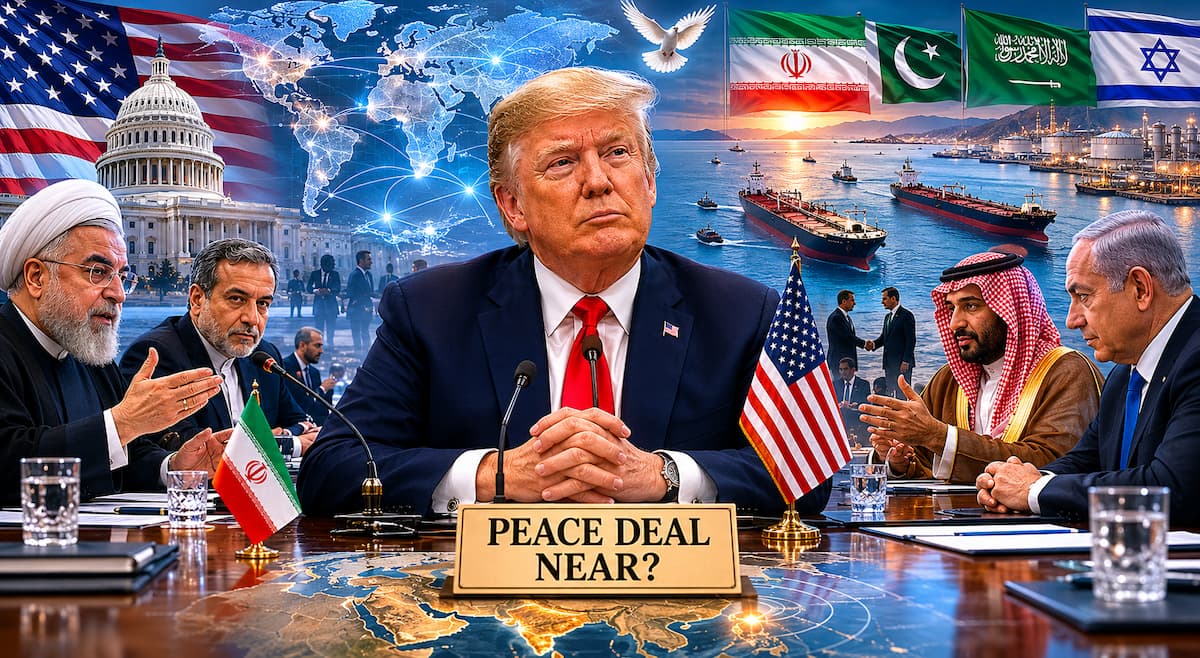
Former US President Donald Trump has sparked global attention after claiming that a major peace agreement involving the United States, Iran, and several Middle Eastern nations is close to completion. According to Trump, negotiations have reached an advanced stage, with only the “final details” of the agreement still under discussion. His announcement has raised hopes for easing tensions in the Middle East, particularly after months of heightened conflict and diplomatic uncertainty. In a statement shared on his social media platform, Trump suggested that the proposed agreement could lead to the reopening of the Strait of Hormuz, one of the world’s most critical oil shipping routes. The narrow passage is vital for global energy supplies, and any disruption in that region can significantly impact international oil markets and trade.. Trump suggested that the agreement included collaboration among Washington, Tehran, and various key regional players.Nonetheless, Iranian authorities promptly disputed Trump’s account of the situation. Iran’s Fars News Agency, recognized for its strong ties to the Islamic Revolutionary Guard Corps (IRGC), refuted allegations that authority over the Strait of Hormuz would alter under any accord. The agency insisted that Iran would continue to maintain full authority over ship access, routes, and maritime permissions in the strategic channel. Tehran has historically viewed the strait as a matter of national sovereignty and security, making it one of the country’s key non-negotiable issues. Meanwhile, Pakistan has emerged as a significant diplomatic player in the ongoing talks. Prime Minister Shehbaz Sharif welcomed Trump’s peace efforts and described recent discussions among regional leaders as productive and encouraging. Pakistan reportedly plans to host another round of negotiations involving Saudi Arabia, Qatar, Turkey, Egypt, the UAE, Jordan, and Israel. The country’s military leadership, including General Syed Asim Munir, has also taken part in high-level diplomatic meetings with Iranian officials in Tehran. According to reports from international media outlets, Iran and Pakistan recently submitted an updated proposal to the United States. The draft agreement reportedly includes a 60-day ceasefire extension, reopening the Strait of Hormuz without additional tolls, and allowing Iran to resume unrestricted oil exports. In return, Washington could ease restrictions on Iranian ports and potentially release billions of dollars in frozen Iranian assets. The proposal also includes discussions aimed at limiting Iran’s nuclear activities and reducing violence in both Iran and Lebanon. Further signs of diplomatic progress emerged when US Secretary of State Marco Rubio hinted during a visit to India that important developments could soon be announced. At the same time, Trump warned that military action against Iran remained possible if negotiations collapsed. He confirmed that discussions had involved leaders from Saudi Arabia, the UAE, Qatar, Egypt, Jordan, Bahrain, Turkey, Pakistan, and Israeli Prime Minister Benjamin Netanyahu. Despite growing optimism, uncertainty still surrounds the negotiations. Critics within the Republican Party, including former Secretary of State Mike Pompeo, have strongly opposed the rumored terms. Pompeo argued that the proposed framework resembles the 2015 Iran nuclear agreement brokered during the Obama administration — a deal Trump abandoned in 2018. He warned that easing sanctions could strengthen the IRGC and weaken US leverage over Tehran. As conflicting narratives continue to emerge, the future of the negotiations remains unclear. Still, the involvement of multiple global and regional powers suggests that the coming weeks could prove critical in determining whether diplomacy succeeds or tensions escalate further in the Middle East.