
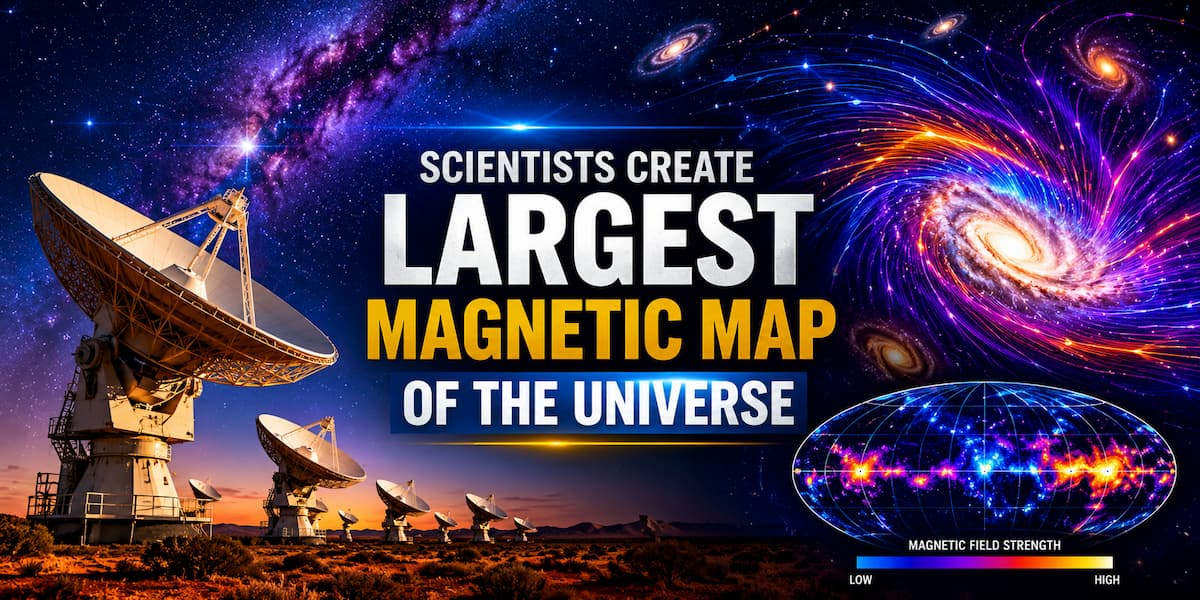
With the publication of the largest magnetic map of the cosmos ever made, astronomers have made a significant advancement in space travel. The groundbreaking project is expected to help scientists unlock new insights into the invisible forces that shape galaxies, stars, and the vast regions of space between them.
The newly developed map represents a significant advancement in astronomical research, covering a scope that surpasses all previous magnetic mapping efforts combined. Researchers believe the data will provide valuable clues about how cosmic structures formed and evolved over billions of years.
The achievement was made possible through an international collaboration involving scientists from multiple countries, led by Australia’s national science agency, CSIRO, and the SKA Observatory (SKAO). The project relied heavily on observations collected by the Australian Square Kilometre Array Pathfinder (ASKAP), a powerful radio telescope located in the remote Murchison region of Western Australia.
A New Window Into the Invisible Universe
The map, known as SPICE-RACS, focuses on magnetic fields that exist throughout the universe but cannot be seen directly. Instead, researchers detect their presence by observing how radio waves change as they travel through space.
Light’s characteristics slightly change as it travels through magnetic areas. By measuring these changes, astronomers can identify the location and strength of magnetic fields across enormous distances.
Using ASKAP’s advanced technology, scientists analyzed signals from nearly four million galaxies. The information was then combined and processed to generate an unprecedented view of cosmic magnetism on a massive scale.
Experts describe the project as a transformational step forward in understanding some of astronomy’s biggest unanswered questions. Until now, researchers had been relying on significantly older and more limited datasets that provided only a partial view of the sky.
Unlocking Ancient Cosmic Mysteries
One of the most exciting aspects of the new map is its potential to reveal when magnetic fields first emerged in the universe. These fields play a critical role in shaping galaxies, influencing star formation, and guiding the movement of charged particles through space.
Scientists hope that studying the newly collected data will help explain how magnetic forces evolved alongside the universe itself. The findings could also improve our understanding of the vast cosmic web — the enormous network of galaxies and matter that stretches across the cosmos.
Researchers say the project creates opportunities for discoveries that were previously impossible due to limitations in available data.
Data Available to Scientists Worldwide
The magnetic map has been made accessible through CSIRO’s scientific data portal, allowing research teams around the globe to explore and analyze the information.
Open access to the information is expected to accelerate future discoveries and encourage greater international collaboration in astrophysics.
Bigger Discoveries on the Horizon
The success of SPICE-RACS highlights the capabilities of ASKAP, which can survey vast portions of the sky with remarkable speed and sensitivity. The telescope continues to play a crucial role in mapping radio signals throughout the universe.
Even larger scientific instruments are currently under construction as part of the Square Kilometre Array project in Australia and South Africa. These next-generation telescopes are expected to begin operations later this decade and will offer even more detailed observations of the universe.
Scientists believe the upcoming facilities could help answer some of the most profound questions in modern astronomy, including the origin of cosmic magnetic fields and the structure of the universe on its largest scales.
The largest magnetic map in the world represents an important turning point in humanity’s efforts to comprehend the unseen forces that govern the cosmos.