
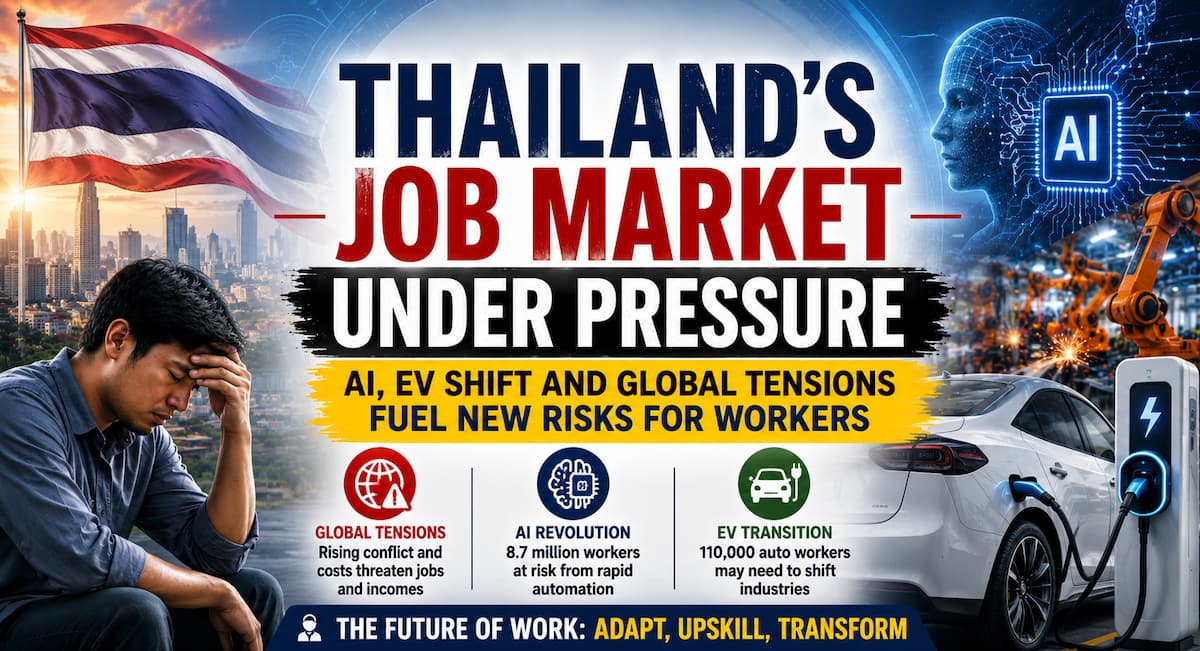
Thailand is entering a challenging period for its labour market as officials warn that global conflicts, rapid advances in artificial intelligence, and the fast-growing electric vehicle industry could threaten thousands of jobs in the coming years.
According to the National Economic and Social Development Council (NESDC), Thailand’s economy continues to create employment opportunities, especially in the agriculture and service sectors. However, new labour data also highlights increasing vulnerabilities for workers and businesses across the country.
During the first quarter of 2026, total employment in Thailand reached 41.2 million people, marking a 4.6% increase compared to the same period last year. Despite the improvement, unemployment also climbed to 0.94%, representing nearly 390,000 unemployed people. This was higher than both the previous quarter and the same period in 2025.
Officials expressed concern that many unemployed individuals were previously employed workers who had lost their jobs rather than first-time job seekers. Long-term unemployment — people without work for more than one year — jumped by 27%, signaling deeper economic stress in some sectors.
The NESDC also reported a rise in hidden unemployment and underemployment, particularly among agricultural workers and people with lower education levels. Quasi-unemployment, where workers are employed for limited hours or earn insufficient income, increased by 3% in non-agricultural industries.
One of the biggest concerns for Thailand’s economy is the ongoing conflict in the Middle East. Rising geopolitical tensions could increase global oil prices and operating costs for businesses, placing additional pressure on employers and workers already struggling with higher living expenses.
Many Thai workers continue to depend on agriculture, where incomes remain unstable. The agency urged the government to improve worker productivity and promote secondary occupations that can help households earn additional income.
Average working hours in Thailand remained relatively stable at 40.9 hours per week, while private-sector employees averaged nearly 44 hours weekly. Around 6.1 million people were found to be working overtime for 50 hours or more every week.
Average monthly earnings fell slightly to 16,145 baht per month. Self-employed workers experienced a sharper decline in income, while formal employees saw only a modest increase in wages after inflation adjustments.
The NESDC warned that advanced generative AI and next-generation agentic AI technologies are rapidly transforming workplaces by automating tasks once handled by humans.
Government estimates suggest around 8.7 million Thai workers — roughly 22% of the labour force — could be affected by AI-driven changes. Industries relying heavily on routine administrative or repetitive tasks may face the greatest disruption.
Meanwhile, Thailand’s transition toward electric vehicles is expected to reshape the automotive industry. The government aims for EV production to account for 30% of total vehicle manufacturing by 2030 and 50% by 2035.
As production of traditional combustion-engine vehicles declines, many automotive parts suppliers could face serious challenges. Experts note that electric vehicles require far fewer parts compared to conventional cars, reducing demand for many manufacturers.
The NESDC estimates that more than 110,000 automotive workers could be at risk of losing jobs or being forced to switch industries over the next two years. Authorities are now being encouraged to support affected businesses and workers by helping factories transition into emerging industries such as EV components and medical technology manufacturing.