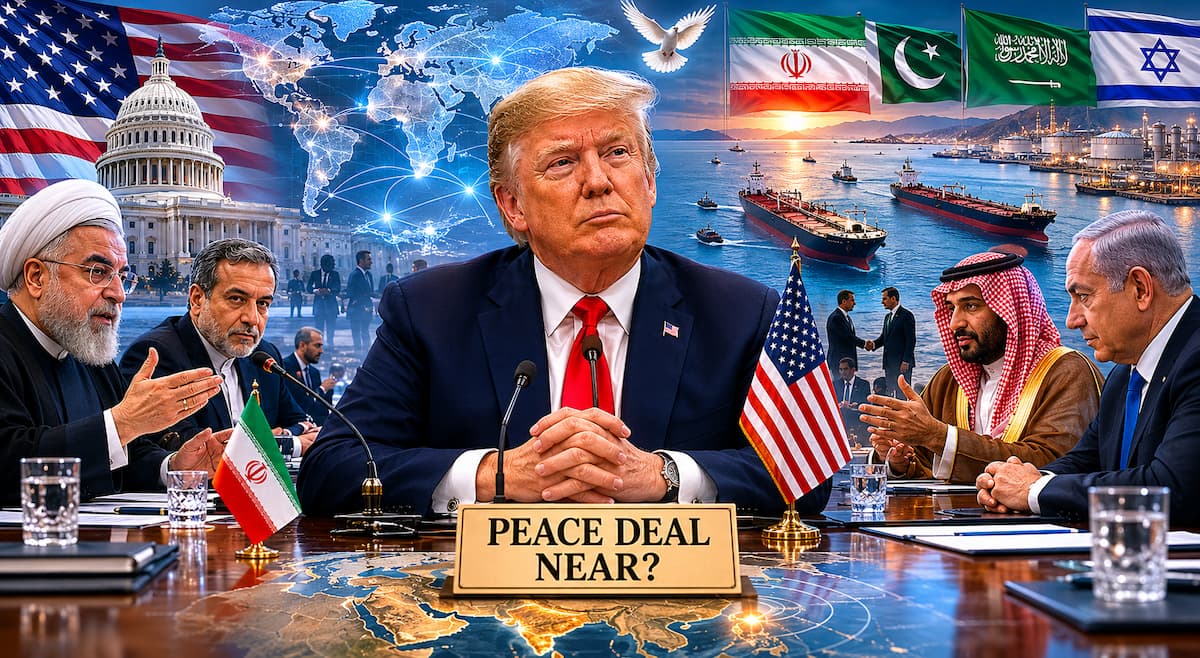
Former US President Donald Trump has sparked global attention after claiming that a major peace agreement involving the United States, Iran, and several Middle Eastern nations is close to completion. According to Trump, negotiations have reached an advanced stage, with only the “final details” of the agreement still under discussion. His announcement has raised hopes for easing tensions in the Middle East, particularly after months of heightened conflict and diplomatic uncertainty. In a statement shared on his social media platform, Trump suggested that the proposed agreement could lead to the reopening of the Strait of Hormuz, one of the world’s most critical oil shipping routes. The narrow passage is vital for global energy supplies, and any disruption in that region can significantly impact international oil markets and trade.. Trump suggested that the agreement included collaboration among Washington, Tehran, and various key regional players.Nonetheless, Iranian authorities promptly disputed Trump’s account of the situation. Iran’s Fars News Agency, recognized for its strong ties to the Islamic Revolutionary Guard Corps (IRGC), refuted allegations that authority over the Strait of Hormuz would alter under any accord. The agency insisted that Iran would continue to maintain full authority over ship access, routes, and maritime permissions in the strategic channel. Tehran has historically viewed the strait as a matter of national sovereignty and security, making it one of the country’s key non-negotiable issues. Meanwhile, Pakistan has emerged as a significant diplomatic player in the ongoing talks. Prime Minister Shehbaz Sharif welcomed Trump’s peace efforts and described recent discussions among regional leaders as productive and encouraging. Pakistan reportedly plans to host another round of negotiations involving Saudi Arabia, Qatar, Turkey, Egypt, the UAE, Jordan, and Israel. The country’s military leadership, including General Syed Asim Munir, has also taken part in high-level diplomatic meetings with Iranian officials in Tehran. According to reports from international media outlets, Iran and Pakistan recently submitted an updated proposal to the United States. The draft agreement reportedly includes a 60-day ceasefire extension, reopening the Strait of Hormuz without additional tolls, and allowing Iran to resume unrestricted oil exports. In return, Washington could ease restrictions on Iranian ports and potentially release billions of dollars in frozen Iranian assets. The proposal also includes discussions aimed at limiting Iran’s nuclear activities and reducing violence in both Iran and Lebanon. Further signs of diplomatic progress emerged when US Secretary of State Marco Rubio hinted during a visit to India that important developments could soon be announced. At the same time, Trump warned that military action against Iran remained possible if negotiations collapsed. He confirmed that discussions had involved leaders from Saudi Arabia, the UAE, Qatar, Egypt, Jordan, Bahrain, Turkey, Pakistan, and Israeli Prime Minister Benjamin Netanyahu. Despite growing optimism, uncertainty still surrounds the negotiations. Critics within the Republican Party, including former Secretary of State Mike Pompeo, have strongly opposed the rumored terms. Pompeo argued that the proposed framework resembles the 2015 Iran nuclear agreement brokered during the Obama administration — a deal Trump abandoned in 2018. He warned that easing sanctions could strengthen the IRGC and weaken US leverage over Tehran. As conflicting narratives continue to emerge, the future of the negotiations remains unclear. Still, the involvement of multiple global and regional powers suggests that the coming weeks could prove critical in determining whether diplomacy succeeds or tensions escalate further in the Middle East.